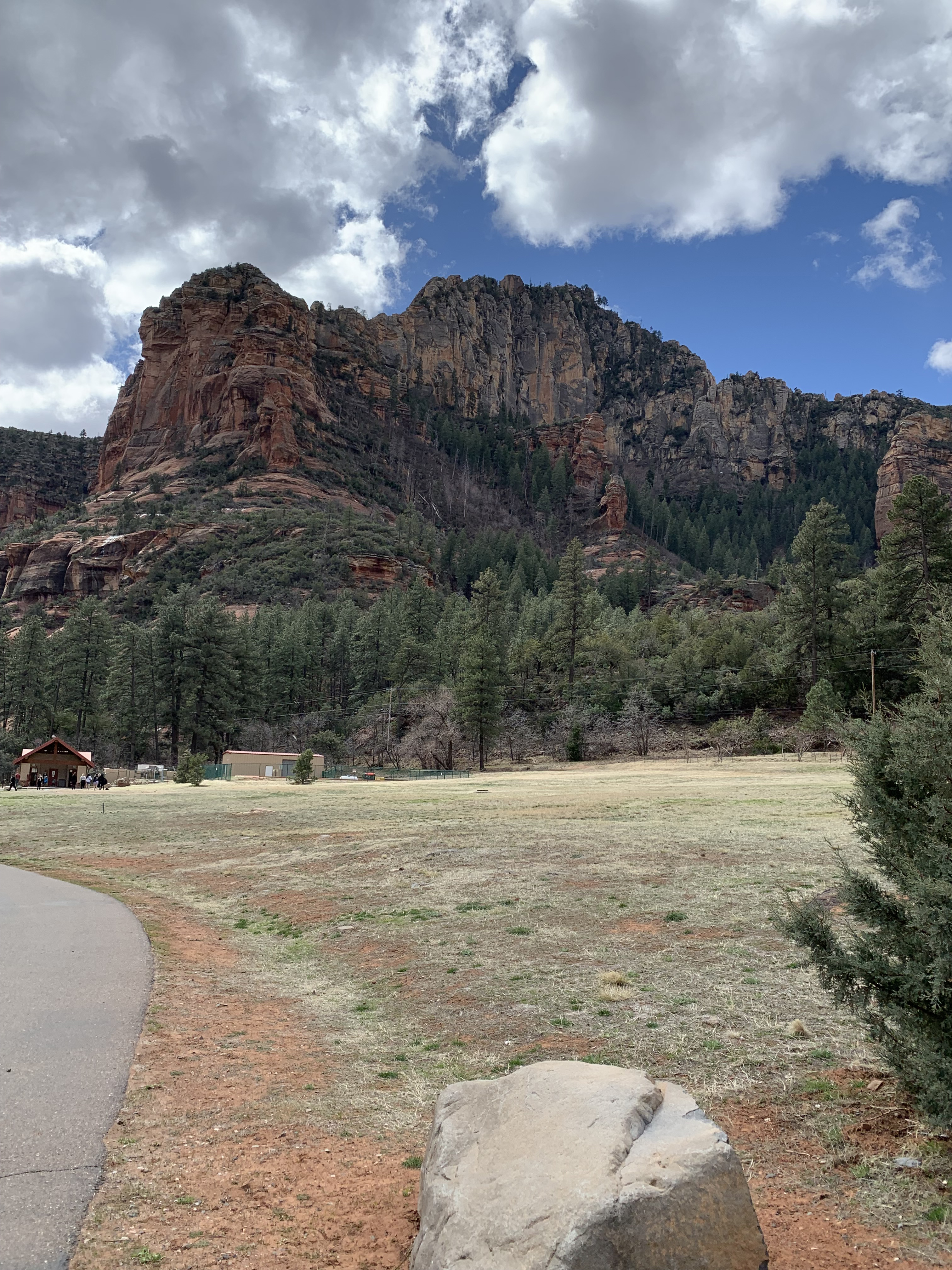
After a LOOOONNNGGG winter's nap in Arizona, it was time to get back on the road. But first, a few things to see before we left the area.
Jerome was founded in the late 19th century on Cleopatra Hill and is more than 5,000 feet above sea level. It is about 100 miles north of Phoenix and between Sedona and Prescott. It was supported by rich copper mines in its heydey and was home to more than 10,000 people in the 1920s. As of the 2020 census, the population was 464.
Jerome made news in 1917 when labor unrest involving the Industrial Workers of the World (IWW) led to the expulsion at gunpoint of about 60 IWW members who were loaded on a cattle car and shipped west. Production at the mines boomed during World War I, fell after, rose again, and then fell again during the Great Depression. The mines closed for good in 1953 and the population dwindled to fewer than 100. Efforts to save the town succeeded when residents turned to tourism and retail sales. Jerome became a National Historic Landmark in 1967.
We'd walked the town years ago (it's a tough walk) so this time focused on driving. Our excuse was that it's tough to park the truck :-) This gives a feel of what the town looked like in the day.
We stopped at the local shop specializing and affiliated with a copper museum (more on that in a minute).
We remembered our last visit and that a nice woman had helped us. Turns out, since her passing her son, Drake, has managed the shop (which is the gift shop for the museum). And he was an integral part of the formation of the copper museum. If you ever want to know anything about copper, he's your guy!
Of course, Ron gravitated to the copper nuggets. These nuggets were found in a lake which caused the patina. Once collected, the nuggets are partially polished to display the beautiful copper coloring. Yes, he bought one.
It was time to take the short drive to Clarkdale.
Clarkdale was founded in 1912 as a company smelter town by William Clark, for his copper mine in Jerome. It was one of the most modern mining towns in the world, including telephone, telegraph, electrical, sewer, and spring water services and was an early example of a planned community. The Clark Mansion, a local landmark, was built in the late 1920s by William Clark III, Clark's grandson and heir to the United Verde Copper Company. The structure, east of town across the Verde River near Pecks Lake, was destroyed in 2010 by a "suspicious" fire.
The mine and smelter closed in 1953 and Clarkdale entered hard times. The town was bought and sold by several different companies and in 1957, Clarkdale was incorporated as a town. The 1959 construction of the Phoenix Cement Company (now Salt River Materials Group) plant restored a modest prosperity to the community. According to the most recent census, the population of the now largely retirement and arts community was 4,419.
The "main event" in Clarkdale is the Copper Museum, housed in the old high school building.
John and Patricia (Drake's parents from the store we'd visited) became involved with copper in 1958 when they saw a few copper molds in an antique store. This inspired them to begin collecting copper and open a store. The store closed in the 1970s as they preferred selling copper at antique shows in large American cities. Their son, Drake, joined the business in 1978.
The family thought about sharing their copper collection with the public and made plans for a museum. Drake searched for two years for the best location and decided on Clarkdale. They had chosen Arizona due to it being nicknamed "The Copper State" while Clarkdale was a city known for its past as a copper smelting town producing billions of pounds of copper, silver, and gold. The old high school was for sale but in poor condition and was purchased in 2002. Restoration of the building and incorporation of their existing collections began in 2004. The high school had operated from 1928 to 1960 and sat virtually empty until it was purchased in 2002. After eight years of restoring the building and preparing the exhibits, the museum opened in 2012 during the centennial celebrations of both Clarkdale and Arizona. The museum displays over 5,000 copper artifacts and won the Arizona Governor's Tourism Award in 2014.
There are some items on display from the Clark Mansion.
Clark Mansion Archway, 1927
Clark Mansion Fireplace Mantel, 1927
The exhibits are all so interesting. One room was dedicated to trench art, a form of art made by soldiers in World War I and II. The trench art in the room are expended artillery shell casings and are made of brass, an alloy of copper and zinc.
The shell casings here are French 75MM. Fascinating.
This clock is a Comtoise (or Morbier) clock from the 1800s. This clock is a form of provincial, weight-driven clock originally made in the vicinity of Morbier in France.
European legends describe a basilisk as a legendary reptile reputed to be a serpent king, who causes death to those who look into its eyes. According to the Naturalis Historia of Pliny the Elder, the basilisk of Cyrene is a small snake "being not more than twelve inches in length" that is so venomous it leaves a wide trail of deadly venom in its wake, and its gaze is likewise lethal.
Basilisk Crest, Germany, 1917
A copper and wood document casket from the 1600s in Italy.
How would you like to take a bath like this?
Entire "themed" rooms. I think my favorite was the drinking room.
Turning water into wine.
Beer Mugs. How many bottles or cans would fit in there?
I need this table!
The cooking room was interesting. Ron's mother was the queen of jello salads - she would have loved to see all of these molds.
These teakettles are from the 1800s - 1900s from N. Africa and the Middle East.
And some other special items....
The collection is amazing - incredible the number of items made with copper.