Tuesday, December 5, 2023

White Sands, New Mexico

As we were traveling west, we stopped for a week in Las Cruces to re-visit the area and have the opportunity to explore White Sands.  We'd driven by it last year but didn't have the time to stop.  So this was our chance.

White Sands National Park is completely surrounded by the military installations of White Sands Missile Range and Holloman Air Force Base, and has always had an uneasy relationship with the military.  The missile range and air force base were established after the bombing of Pearl Harbor, with continuing operations after World War II and throughout the Cold War.  Errant missiles often fell within the park's boundaries, occasionally destroying some of the visitor areas.  Flight training missions continue over the dunefield, and the park closes temporarily for several hours during missile tests.

The park covers 145,762 acres (227.8 square miles), including the southern 41% of a 275 square mile field of white sand dunes composed of gypsum crystals.  This gypsum dunefield is the largest of its kind on Earth and is so large that it can be seen from space!

Approximately 12,000 years ago, the land featured large lakes, streams, grasslands, and Ice Age mammals.  As the climate warmed, rain and snowmelt dissolved gypsum from the surrounding mountains and carried it into the basin.  Further warming and drying caused the lakes to evaporate and form selenite crystals.  Strong winds then broke up crystals and transported them eastward - a similar process continues to produce gypsum sand today.

Fortunately, we arrived fairly early in the day so there weren't many people when we went into the Visitor Center to learn more about the park.

There were a lot of items of interest - check out these fossilized footprints from the Ice Age.


The Selenite that is formed is most commonly transparent when fresh from extraction.  However, there have been many Selenite color varieties found the past few decades.

Selenite is always associated with simplicity, innocence, devoutness, and beauty.  Its name is undoubtedly derived from Selene, a Greek divine figure, also known as the moon goddess.  Many of its essences revolve around spirituality.  

Selenite healing properties can help with physical, emotional, and spiritual balance and issues.  It has healing powers to help with physical ailments and emotional issues.  Selenite healing crystal therapies include clearing blockages, stabilizing emotions, and bringing flexibility.

So, of course, we had to find some to have on our continued journey.  


Outside they were holding a bazaar in the courtyard.  We didn't really shop but it was a nice place to sit and people watch.

And then it was time to drive into the park.  Love that Senior National Parks Pass that I paid $5 for about 5 years ago - boy has that saved us money!

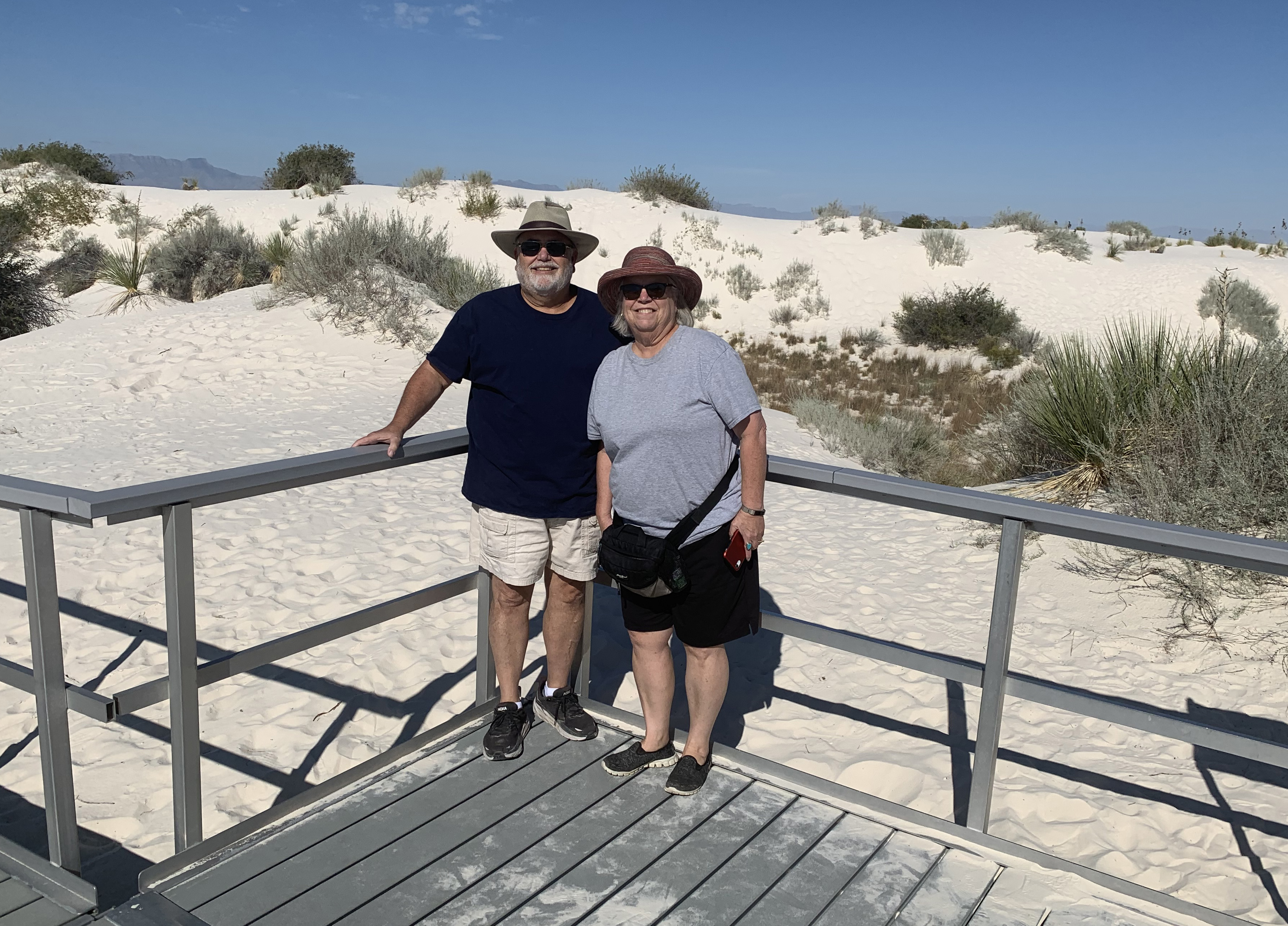
Our first stop was a boardwalk where you could walk out to the dunefield to enjoy the view and take some photos.


Detail on the sign:  When you drive farther into the park, you will find yourself surrounded by a vast field of white sand dunes, extending for miles in every direction.  Perhaps you will pack up a handful of sand and let it slip through your fingers.  This sand was once rock high in the surrounding mountains.

We talked to a nice family visiting while traveling from Tucson to Colorado and they were kind enough to take a photo of us.


We then drove further on Dunes Drive, which leads 8 miles into the dunes from the Visitor Center, in order to see this amazing sight.  It is said that the sand measures 30 feet in depth.

No, that's not us - just some random people

Sledding on the beautiful soft sand is a popular activity and great fun for children and adults.  Unlike snow, gypsum is not slippery and sledding down the face of a dune can take some practice unless you have the correct equipment, know proper techniques and use safety precautions.  Waxed plastic snow saucers work best and can either be brought from home or purchased at the gift shop.  


These people were having a blast!


We stopped for a bit to talk with a delightful family.  The parents were both born in India but met each other while working in the United States.  Their little girl couldn't get enough of the sand.  I can't even describe how soft it is and nothing like the sand you'd find at the beach.  Another interesting fact about the gypsum is that it is actually clear, but appears white and, therefore, doesn't absorb the sun's heat like silica sand.  So even on those intensely hot New Mexico days, the sand remains cool to the touch.


Ron likes to take a picture of our truck as we visit different places - boy has it traveled well!


Coincidentally, since we visited White Sands we saw the movie Oppenheimer which details the "father of the atomic bomb", J. Robert Oppenheimer, who was the director of the Manhattan Project's Los Alamos Laboratory during World War II.  It was interesting to see the area that was used to detonate the first atomic bomb as it wasn't too far in the distance from our visit to the White Sands Park and the city of Alamagordo.  

Many visitors express concern about the amount of residual radiation leftover at the site following the blast of the atomic bomb.  It's been recorded that an hour-long visit to the site yields less exposure to radiation than a visit to the dentist or flight on a plane.

Speaking of Alamagordo, after we left the park we made the 15 minute drive to Alamagordo for some lunch.  We then made a return trip to McGinn's Pistachioland which boasts the largest Pistachio in the world.


We spent some time in the store and went away with some wonderful pistachios and pecans.


We took a walk around the building to enjoy the pistachio orchards.


I'd never seen how pistachios grow.  Now I know or as my dad would have said, I can visualize it.


If you're ever near Las Cruces, make the short trip to White Sands!

Wednesday, November 29, 2023

Dallas/Fort Worth - This and That

A few more places of interest in the Dallas/Fort Worth area.  First up was the Bureau of Engraving and Printing (BEP) in Fort Worth.  

The BEP, founded in 1862, is a government agency with the US Treasury Department that designs and produces a variety of security products, most notably Federal Reserve Notes (paper money) for the Federal Reserve.  The BEP is one of two agencies in United States producing money - the other is the United States Mint which produces coinage.  There are only two BEP facilities in the United States - Washington D.C. and Fort Worth.

We toured the facility in Washington D.C. years ago when we were visiting but, unfortunately, I didn't remember too many details.  We learned that this facility closed to the public during Covid and has yet to reopen.

In 1987, construction began on a second facility in Fort Worth.  In addition to meeting increased production requirements, a western location would serve as a contingency operation in case of emergencies in the DC area; additionally, costs for transporting currency to Federal Reserve banks in San Francisco, Dallas, and Kansas City would be reduced.  Any currency printed at Fort Worth includes a small "FW", usually located to the left of the bill's face plate number, and most also have larger back plate numbers.  Currency production began in December 1990 in Fort Worth.

We were surprised to see the facility parking lot was relatively empty which made parking a breeze.


We walked up to the front to enter the facility and were surprised to see this.


No cell phones?  No cameras?  How in the heck do they expect bloggers to include photos with their posts?  Yes, we asked to confirm and sure enough, we had to take our cell phones back to the truck. :-(

It was an interesting self-guided tour but, unfortunately, we had no way to record any of it.  We looked in the gift shop for some sort of book with pictures and descriptions but they were wise to us and didn't have any.  

We learned that approximately $526 million in paper currency is printed every day, over half of which originates in Fort Worth.  We asked everyone we came in contact with how the money is moved from the Bureau and each person said "we have no idea".  There is an airport nearby so we can only assume that has something to do with moving money.

We had to be content with just one photo of the outside of the building.


And then it was on to Dallas to make some cemetery visits.  I'm sure most people think it's morbid to visit cemeteries but I've always found them interesting as each stone has a story.  And it's interesting to see how people, famous or infamous, are remembered.

One large cemetery had several "famous" people to visit - Sparkman Hillman Memorial Park.


Who hasn't heard of Mickey Mantle?  Nicknamed "the Mick" and "the Commerce Comet", Mickey (October 20, 1931 - August 13, 1995) was a professional baseball player who played his entire major league career (1951-1968) with the New York Yankees, primarily as a center fielder.  He is regarded by many as being one of the best players and sluggers of all time.  He was an American League MVP three times and inducted into the Baseball Hall of Fame in 1974.  

The mausoleum was peaceful and very beautiful.


We found the crypt and were pleased to see that it acknowledged the impact he had on people.  (This is what we had hoped Kenny Stabler would have at his grave).  


Even the Mantle children were there.


We got back in the truck to view some others.


Ross Perot may have been best known for his run for President of the US in 1992 against George H.W. Bush and Bill Clinton.  In the election, Perot did not win any electoral votes but did win over 19.7 million votes for an 18.9% share of the popular vote.  He ran for president again in 1996, establishing the Reform Party as a vehicle for his campaign, and won 8.4% of the popular vote against President Clinton and Republican nominee Bob Dole.

One more stop.


Tom Landry is regarded as one of the greatest head coaches of all time and was the first coach of the Dallas Cowboys, a position he held for 29 seasons (1960-1988) which is an NFL record.  In addition to his record 20 consecutive winning seasons from 1966 to 1985, he won two Super Bowl titles, five NFC titles, and 13 divisional titles.  He was named the NFL Coach of the Year in 1966 and the NFC Coach of the Year in 1975.

Many of you may remember Tom Landry's signature fedora (hat) that he wore on the sidelines when he coached the Cowboys.  It was nice to see that he is remembered with the fedora.


Nearby was Emanu-El Cemetery.  This brought a warm and fuzziness to me as the Temple we worshipped at as kids was Temple Emanu-El.


We found the area we were looking for......


We'd just visited the 6th Floor Museum where we remembered Abraham Zapruder, the clothing manufacturer who witnessed the assassination of President John F. Kennedy in 1963.  He unexpectedly captured the shooting in a home movie while filming the presidential limousine and motorcade as it traveled through Dealy Plaza.  The film is regarded as the most complete footage of the assassination.

RIP, Mr. Zapruder

And then it was on to visit two of the infamous people in the area.


Not in the mausoleum but nearby was Bonnie Parker, one half of the legendary crime duo Bonnie and Clyde, who traveled with their gang during the Great Depression.  The couple was known for their bank robberies, although they preferred to rob small stores or rural funeral homes.  They are believed to have murdered at least nine police officers and four civilians.


Bonnie Elizabeth Parker
1910-1934

Bonnie and Clyde wished to be buried side by side, but the Parker family would not allow it.  Her mother wanted to grant her final wish to be brought home, but the mobs surrounding the Parker house made that impossible.  More than 20,000 attended Parker's funeral, and her family had difficulty reaching her gravesite.  Bonnie was originally buried in Fishtrap Cemetery, although her body was moved in 1945 to the new Crown Hill Cemetery to be buried alongside her mother.  

Emma Parker
1885-1944

Of course we had to go across town to see Clyde Barrow.  Thousands of people gathered outside both Dallas funeral homes, hoping for a chance to view the bodies.  Clyde Barrow was buried in Western Heights Cemetery next to his brother, Marvin.  


The Barrow brothers share a single granite marker with their names on it and an epitaph selected by Clyde: "Gone but not forgotten."


Their parents are buried alongside them.


The American National Insurance Company of Galveston, Texas, paid the life insurance policies in full for Bonnie and Clyde.  Since then, the policy of payouts has changed to exclude payouts in cases of deaths caused by any criminal act by the insured.

Phew, that was a long day.


Friday, November 10, 2023

Dallas - Sixth Floor Museum

One of the reasons we wanted to go to Dallas was to visit the Sixth Floor Museum, which on November 22, 1963 was known as the Texas School Book Depository.  We were there about 15-20 years ago but since we (or at least I) was infatuated with the JFK assassination in 1963, we wanted to go back.


In 1963, the building was in use as a multi-floor warehouse storing school textbooks and other related materials and an order-fulfillment center.  The company found that the upper floors had sustained oil damage from items stored there by the previous tenant so they began to cover the floors with plywood to protect their books.  Work had begun on the west side of the sixth floor just before President Kenney's motorcade, "leaving the whole scene in disarray, with stock shifted as far as the east wall, and stacks in between piled unusually high."

Model of the Texas School Book Depository

The interior of the museum has been left just as the depository was in 1963.


Of course, a view of the Sixth Floor is a place of extreme interest.  

Sixth Floor in 1963

Recreated Sixth Floor sniper's nest

From the Sixth Floor, you can look out the windows to witness the view of the motorcade that day.

View of the approach of the motorcade - Houston Street

View of Elm Street - the trees have grown so that the point of impact is difficult to see


This Italian-made Mannlicher-Carcano rifle is identical to the rifle found by investigators in the northwest corner of the sixth floor following the assassination.  That weapon, traced to Depository employee Lee Harvey Oswald, is now in the National Archives.


Jack Ruby wore this gray fedora when he shot Lee Harvey Oswald in the basement of Dallas police headquarters.  Manufactured in New York by Cavanagh Hats, the hat was purchased by Ruby at James K. Wilson in Dallas.


I'll never forget Sunday, November 24, 1963.  My dad picked us up from the temple (Sunday School) and told us that Lee Harvey Oswald had been murdered on national TV.  This was definitely not something that was common place in 1963.

Dallas Police homicide detective Jim Leavelle wore this suit when nightclub owner Jack Ruby shot Lee Harvey Oswald.  The suit, from luxury retailer Neiman-Marcus, was given to Leavelle by a friend who could no longer wear it.  Leavelle purchased the Resistol brand hat at the company's store in Garland, Texas.

Note the handcuffs keeping Oswald restrained

Oswald bought this ring at a jewelry store in Minsk, Russia, in April 1961.  He apparently never took off the ring.

"What motivated this action [leave the ring on the nightstand] on November 22, 1963?" said Stephen Fagin, an associate curator at The Sixth Floor Museum.  "For many researchers, it is the symbolic act of a man who knows he can never go home again.  Whether or not one chooses to directly link this to the assassination, Oswald's action that morning were certainly uncharacteristic and remain open to debate more than a half a century later.  The ring provides a tantalizing window into the mindset of Lee Harvey Oswald."


At the Dallas Trade Mart, where a luncheon was to be held after the motorcade, this place was set and waiting for the President.


The Zapruder film is a silent 8mm color motion picture sequence shot by Abraham Zapruder with a Bell & Howell home movie camera as the JFK motorcade passed through Dealey Plaza and captured the assassination of the President.  Although it is not the only film of the shooting, this film as been described as being the most complete, giving a relatively clear view from a somewhat elevated position on the side from which the president's fatal head would is visible.  It is one of the most studied pieces of film in history.

The original camera is held in the National Archives - this is an identical camera.


It was time to go outside and look around.  This is a good model of the area.


The infamous grassy knoll.


This elevated section in the grassy knoll is where Abraham Zapruder stood to film the motorcade as it passed by.


It was crazy to see a big "X" in the middle of the road designating where the limo was when the President and Governor Connolly were shot.


Not only to see the "X" but to see people running into the road when traffic was stopped to take a photo.


After seeing the museum and surrounding area, we moved on to see a few other notable sites.


Beginning October 14, 1963, Lee Harvey Oswald rented a small room in this house, approximately 2 miles from the Book Depository, for $8 a week.  He slept there on weeknights, and went back on weekends to suburban living, where his wife and children were living.  


On November 22, 1963, Oswald returned to his room immediately after the assassination.  Shortly thereafter, Oswald was confronted by Dallas Police officer J.D. Tippit less than a mile away from the house.  After exchanging a few words, Oswald allegedly shot Tippit and a short time later was arrested at the Texas Theater.


In 1963, the Texas Theater was the largest suburban theater in Dallas and part of a chain of theaters financed by Howard Hughes.  The theater is most famous for being the site of Lee Harvey Oswald's arrest shortly after the assassination. The theater closed in 1989 and the Texas Theater Historical Society purchased it the following year.  This allowed Oliver Stone to remodel the exterior facade for his 1991 film, JFK.  However, by 1992 the Society was no longer able to fund the property and the theater closed again.  There have been several occasions since where there were plans to demolish the theater.

In 2001, the Oak Cliff Foundation acquired the structure and began renovations after receiving $1.6 million from the Dallas Neighborhood Renaissance Partnership.  Since then, the board of the Oak Cliff Foundation has raised an additional $2 million of the estimated $9 million needed to complete renovation of the theater.  The foundation used the funds to secure and restore the building needed after years of neglect and fire damage and the venue began hosting movies and special events soon after.  In 2010, Aviation Cinemas signed a lease to operate the theater as an independent and repertory cinema with hopes of presenting live theater and concerts in the future.


And because we like to visit cemeteries, the day would not have been complete without visiting the Shannon Rose Hill Memorial Park in Fort Worth to see the grave of Lee Harvey Oswald.


Oswald's original headstone, a simple granite slab bearing his full name, birthdate, and a cross, was stolen on the four year anniversary of Kennedy's death.  His mother replaced the stone with this red stone that reads simply "Oswald."

The original marker was eventually returned to Oswald's mother, who, believing it would just be stolen again off of the grave, instead placed it in the crawl space of her Fort Worth home.  After her death, the home, along with all of its "contents", was sold in the early 1980s.

The marker, which was discovered by an electrician working under the home, eventually landed in the hands of the owner's distant relative who sold it to the owner of a museum in Illinois for $45,000.  The homeowner argued that the relative did not have the right to sell the marker and the gravestone was returned to the homeowner who brought it back to Texas.  It is currently stored in an undisclosed location.


After Oswald's burial, the location of the grave was not disclosed to keep the curious out.  Enter comedian Nick Beef (stage name) who purchased the plot next to Oswald in 1975.  Then in 1997, he erected a headstone with his own professional moniker with an empty grave below.  Anyone looking for Oswald's grave wouldn't be given information, but those in search of Nick Beef would be given the location which would ultimately lead to Oswald.  The plan soon fell through, however, as the cemetery caught wind of the stunt and will no longer direct visitors to Nick Beef.

The description of the grave location on findagrave.com shows Oswald's grave location as Section: Fairlawn 17.  Precise location about 30 feet to the right of a big tree across from a mausoleum marked SHANNON.  About 30ft NW of the steps west of the red granite mausoleum.

We were able to find the graves but it took us some research to figure out who Nick Beef was and why he is "buried" next to Lee Harvey Oswald.