Sunday, June 26, 2022

Charleston - Drayton Hall

The next day we set out for Drayton Hall, a National Trust Historic site resting on 630 acres.  The building was completed in 1752 and today it stands as a quality example of Georgian-Palladian architecture; in fact, it is the oldest surviving example of this architectural style.  Owned by the Drayton family for seven generations, the house remains near to its original condition, though it has been through the Revolutionary and Civil Wars, as well as several hurricanes and earthquakes.


The house from the drive is beautiful.


And then we gathered for our tour - there were only a total of 8 people.  Betsy was our tour guide and she carries a ton of information in her brain.


You can see in the painting above the two flanker buildings on either side of the house.  Those are no longer in existence but you can see the foundation where they once stood.  That's the privy in the background - more on that later.


While we stood on the porch, Betsy directed our attention to the pond while she casually said "oh look, there's a gator".  I know it's small but if you use your imagination, you can see him circled right above the water line - he (or she?) was enjoying the sun.


The mansion was built for the grandfather of John Drayton after he bought the property in 1738.  As the third son in his family, John Drayton was unlikely to inherit his own nearby birthplace, now called Magnolia Plantation and Gardens.

For many decades, the house was thought to have been begun in 1738 and completed in 1752.  However, in 2014 an examination of wood cores showed that the attic timbers were cut from trees felled in the winter of 1747-48.  Because the attic framing would have to have been in place well before the completion of the interior finishes, the house is now thought to have been occupied by the early 1750s.  It is believed that the former site of 13 slave cabins housed approximately 78 slaves.  

And then we entered the house.  What's interesting is that while many plantations have been restored with either original artifacts or furnishings of the time period, this mansion has been left empty with the walls, floors, etc. preserved as much as possible.

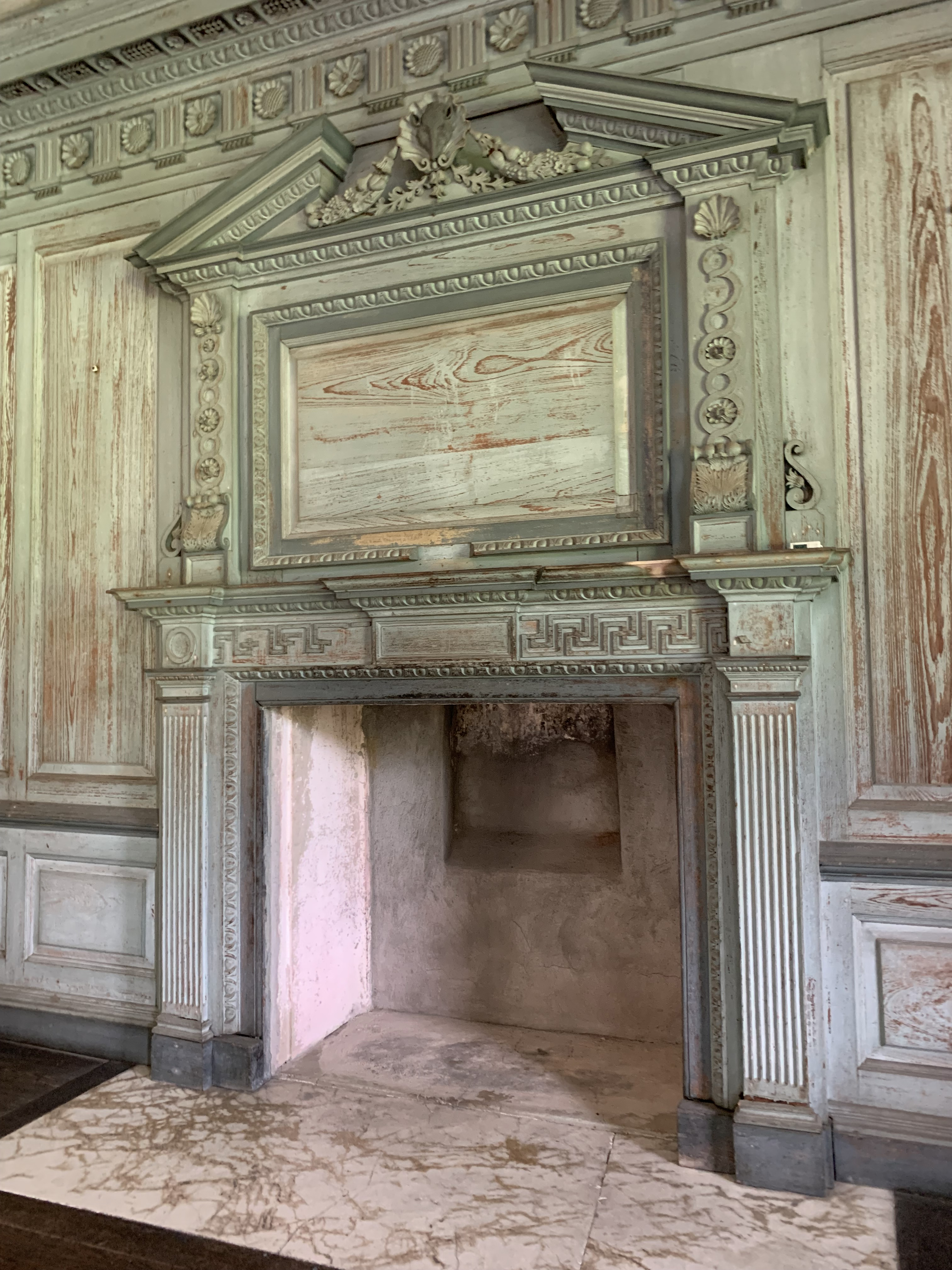
This is what I considered the 'formal' fireplace which was in the front room where guests would have entered and, most often, been entertained in this room.

This main staircase is beautifully preserved and the bannisters and floor are original to the house.


The house is very symmetrical with the back door opposite the front door, two rooms on either side of the grand room, and the same upstairs.

This middle staircase went from the basement to the second floor.  It was likely used to transport food from the kitchen to the upper floors for meals or entertainment.


One of the upstairs bedrooms/office had a "fake" door so that it matched the room next to it.  The door went nowhere but at least it matched the room next door.


An example of one of the original doors.


Interesting to see the graffiti left from the time period.  They really have no idea what or when this is from - do you see the name Simon?


And an upstairs fireplace.


This really touched me - the measurements of the children throughout the years.  This started with the 6th generation up through the 10th generation, most recently measured in December, 2021.


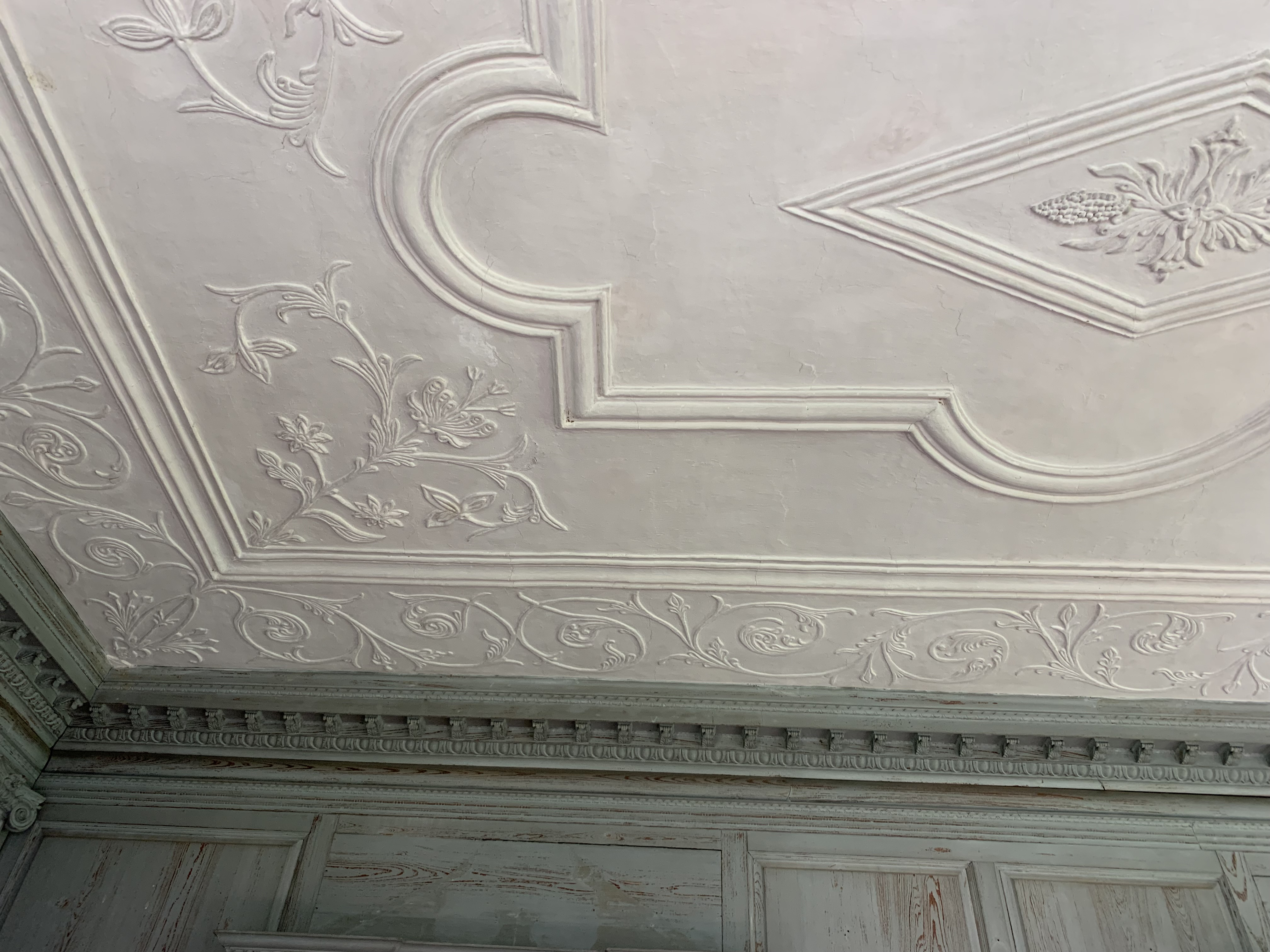
This is the oldest intact plaster ceiling open to the public in the country.  There is no way to know if there is any private building with an older ceiling.

This is the entrance to the cellar where the kitchen was located, as well as some slave quarters.


Back outside we wandered over to the privy.


Can you imagine having to walk outside and across the lawn to go to the bathroom?  Not to mention having maybe more than one person using the toilet at the same time?  Look at the little toilet on the right for children.


At least there was a fireplace.


We walked around the grounds a bit before going back into the gift shop where we talked to Betsy and some of the other tour guides.

And then we were off to downtown Charleston.  Stay tuned.


Saturday, June 25, 2022

Charleston - Fort Sumter

After visiting the Charleston Museum, we moved on to our pre-arranged tour of Fort Sumter.  While we've been to South Carolina before, we've never been to Fort Sumter and it was on Ron's bucket list.


The tour leaves from the same dock where the USS Yorktown is anchored.  There was a graduation ceremony just finishing up and there were LOTS of graduating navy men/women there celebrating with their families.  I wish I'd taken a picture because it seemed very exciting and patriotic.  

This air craft carrier is not the original USS Yorktown CV5 which was sunk at the battle of Midway in 1942. Rather, this was the USS Yorktown CV10 which was the 10th air craft carrier to serve in the US Navy.  Under construction as Bon Homme Richard, this new Essex Class Carrier was renamed in honor of Yorktown CV5.  This air craft carrier saw action during the Viet Nam war and also recovered the vessel for the historic Apollo 8 mission to the moon.


We waited in line and finally boarded our boat.


It was about a 30 minute ride to the fort.  On the way, we ran across this ship exiting the harbor.  The ship is called a RoRo, which stands for Roll On, Roll Off.  The ship had just rolled on 4,000 BMWs that had been manufactured in Spartanburg, about 200 miles from Charleston Harbor, and were headed across the Atlantic Ocean to Europe, and then from there on to the Middle East.


And then the fort came into view.


We were met by some park rangers and after we gathered around, one of them told us some of the history of the fort.


Under the overhang we were sitting at, there were some cannons that exhibited how the fort was defended.  They still have two cannons in their battery placements that are in the same position as they were when attacked by the Confederates. 

Notice the track at the bottom of the screen which enabled the cannon to be moved from side to side


This was the opening where the front of the cannon was exposed to the exterior of the building until it was discharged.  After the discharge, the cannon then kicked back into the fort where it could be reloaded.  There were 1" radius holes in the wheels of the cannon in which, after it was loaded, they inserted rods into the holes of the wheels and used those to move the cannon forward towards the opening so they could repeat the process. 


The track in front of the people's feet


And then we were "set loose" to explore the fort.


The black building in the background of the picture below is Battery Huger, an endicott period battery that was constructed from 1898-1899 and named for the Revolutionary War general Isaac Huger.  Battery Huger protected Charleston Harbor from naval surface attack.  It also included four 9 mm air craft guns which were removed in 1947 upon deactivation of the battery.

 
Officer's quarters and munition storage

This flag now flies above the fort with 33 stars that designate the 33 states that were in the union at that time.


This was the actual flag that flew over the fort at that time.


A great model showing the entire fort as it looked in 1861.


When standing in this spot you can see Fort Johnson, the fort directly south of Fort Sumter, which fired on the fort.


And Fort Johnson from high in the fort.


A good spot to take a photo.


This is part of history.


And just like that, it was time to return to the boat to take us back.


We could see the Yorktown in the distance, as well as the bridge we drove in on to start the tour.


The boat gave us a nice view of the Yorktown as we came back.


What a great day and glad to be able to check something off Ron's bucket list.


Wednesday, June 22, 2022

Charleston - History Museum

We moved on to Charleston which was only about 90 minutes from Hilton Head/Savannah.  We decided to spend 4 days in the area as there was so much to see.  

The first morning we were up and our way to visit the Charleston Museum.

What a great surprise!  They not only had historical exhibits but other things, as well.  This sketch reminds me of the attitudes of today - if you don't "like" the other side, you take your ball and go home.


How many of the signers' graves will we see?


An assortment of slave badges.  These were given to slaves who were authorized to leave the plantation and do work for others.  Sometimes when the work was completed, the owners let them keep the money or other times they might split the money with the slave.


And look at this - the Levys are now making cameras!


Think you'd want to use one of these?


19th Century Cotton Scale.  Cotton was the driving force in the southern economy.  It required the labor of nearly two million enslaved people to grow, harvest, process, transport and export.  By 1860, enslaved people produced over two billion pounds of cotton annually which was two-thirds of the world's supply.


Lots of ammunition and weapons.


And if you needed to settle a serious argument that jeopardized your honor in the community, this was just the thing.


When I see uniforms, I always think about the fact that they were worn continuously in the heat.  How did they clean them?


Since it is a natural history museum, they had a great exhibit on animals.


This museum had some fantastic artifacts and was a real gem.  But we needed to get on the road for our next 'attraction'.  Stay tuned.